Private collection, Italy
Like Turi Simeti, Enrico Castellani or Piero Manzoni, Agostino Bonalumi would develop new possibilities in classical panel painting around 1960 and contribute to the myth in the Italian art scene of the 1960s.
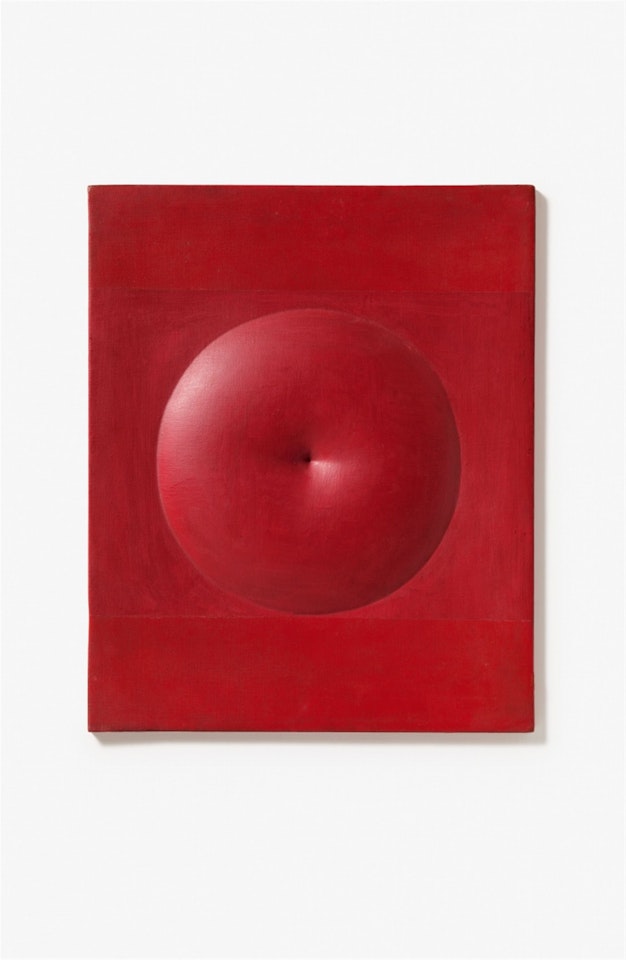
Bonalumi's works are strongly determined by geometric forms. His canvases are object-paintings: three-dimensional bodies fracture the surface of the canvases and expand into the third dimension. The artist understands the aesthetic process here as something process-like in which the canvas picture, characterized by painting, is abandoned and changes into the status of the object-like.
The concept of the protrusion leads to an expansion of the actual, nuance-differentiated colour-surface painting, like the slightly broken tone here, with a very simple, centrally arranged, disc-shaped, cushion-like form in contrast to the rectangle of the panel. In the present, particularly elegant work “Rosso” (positivo) from 1971, the artist achieved more than ever to clarify the above-mentioned principle of his poetics: created by light, the effect shapes the surface. It not only animates the red monochrome, the incursion of light illuminates the flat surface and its raised structure. Bonalumi searches for various solutions, for a profound objectness, in variations modelled in canvas to works of pure plasticity which leave the idea of the extended panel painting behind and change its genre. To solve the great, almost sculptural, urgency, and thereby find many more aspects of the protrusions than his comrades Turi Simeti, Enrico Castellani or Piero Manzoni. In the 1970s, Bonalumi worked primarily in a pronounced three-dimensionality, largely renouncing the painterly element: a pure monochrome canvas conceals the wood elements, revokes the planarity, the peaks or troughs are marked with the help of wires attached to the back. Initially close to Lucio Fontana and Informel, the artist lends a new meaning to the theme of the surface due to its powerful relief effect through the incidence or absorption of light and develops his work in an objective form as an autonomous entity.